 |
| A new book with 59 scenarios for the War of 1812. |

 |
| Sample page of a scenario. |
 |
| Table of Contents. |
 |
|
| A new book with 59 scenarios for the War of 1812. |
|
| Sample page of a scenario. |
|
| Table of Contents. |
|
In the last couple of months, I have had little time for wargaming. While reading Stuart Asquith"s Scenarios for the War of 1812, he recommended "Rocket's Red Glare", published by The Canadian Wargamers Group. I found a copy of it for a reasonable price, so I purchased it.This book also has a quick recap of the war and tactics used. It also has 14 scenarios, including 4 naval scenarios. They are different enough from Mr. Asquith's scenarios to make it a volume worth having.
I bought some semi flats that. were on Ebay for several months. I already have some of these figures; I decided to buy these with the goal of painting them. It is a project started, and then set aside.
While doing little for my blog, I do still follow several blogs daily. Two of them have really caught my attention.Wargaming with 54mm Toy Soldiers and Tradgardland . Both of them have been gaming using late 19th century American style militia, a subject that I have great interest in. Anyone with an interest in colorful uniforms would find the American militias of the19th century worth researching. With that in mind, I bought a couple of lots of old Britain's West Point figures, with the idea of using them as militia. I haven't quite worked out my plans yet, although several of the figures are missing arms. I have two molds with various arms that I can use with these figures. I also had an old figure that I build up a larger shako onto the figure, that I was planning to make a mold out of. Another of the figures is a one piece figure, with the right arm cast onto the figure; this figure will be held as a possible mold master.
 |
| New semi flats for painting. |

 |
| The Arm molds |
 |
| The two figures for possible mold making. |
 |

 |
| My copy of "Rocket's Red Glare" |
 |
| One of the lots of Britains |
 |
| The second lot, bought to experiment on. |


 |
| The battle starts on the American left, where the American militia with Indian allies move forward to engage British forces who had been sniping at the American camp, across the river. |
 |
| The fighting became brisk in the woods. |
 |
| The US allied Indians drive back the Canadian militia. |
 |
| Hearing the increasing volume of fire, the British general leads his army across the Chippawa River. |

 |
| The Americans start sending reinforcements to back up the militia. |

 |
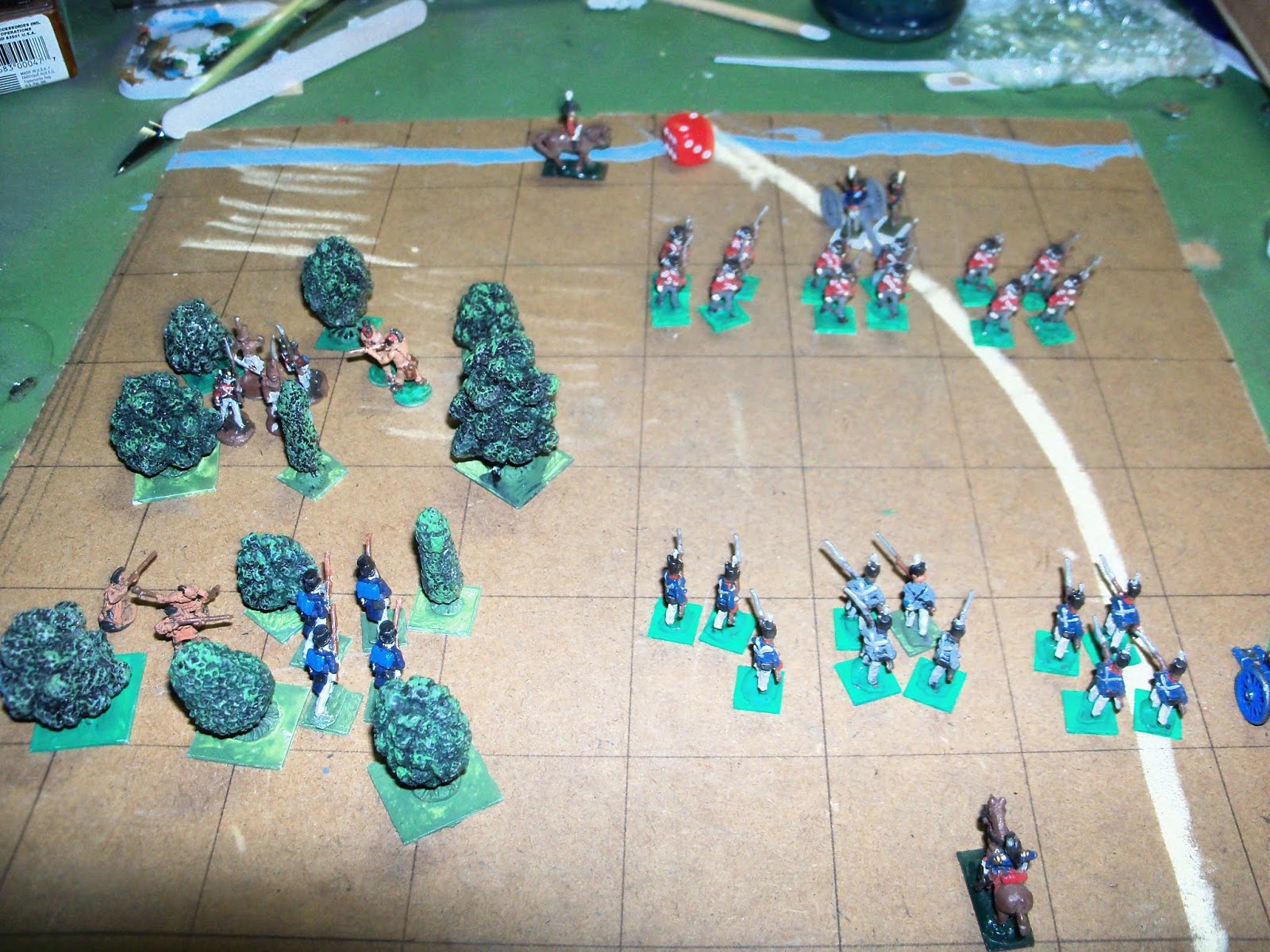
| The regulars on both sides start to deploy into line. |
 |
| The British in the woods start pushing back the American Indians. |
 |
| The American musket fire forces two British units to fall back. |
 |
| The British quickly rally, and start reforming the battle line. |
 |
| The British volleys start shaking the American line. |
 |
| The British right starts advancing. |
 |
| The Americans are being driven back to the river; the American militia is also forced back by the British Indian allies. |
 |
| The American general rallies the American line, and one British unit breaks and falls back towards the river. |
 |
| The Americans, emboldened by seeing one British regular unit break, starts charging forward. |
 |
| One American unit overruns the British battery, and the American artillery fire drives back another unit. |
 |
| The British next move roll is not good; only one unit can move ( each side rolls two dice for movement, and gets the higher roll for movement points). The British general moves the leftmost unit towards the center, to consolidate his line. |
 |
| The British inflects heavy losses on the American infantry on the road, which falls back. Meanwhile, the Canadian Indians have driven the American militia off the field. |
 |
| The American Indians engage the Canadian Indians in the woods. The American line once again moves forward. |
 |
| The Canadian Indians are finally driven off the field; the British line holds fast... |
 |
| .. and once again pushes the Americans back. |
 |
| The Americans try one more charge. |
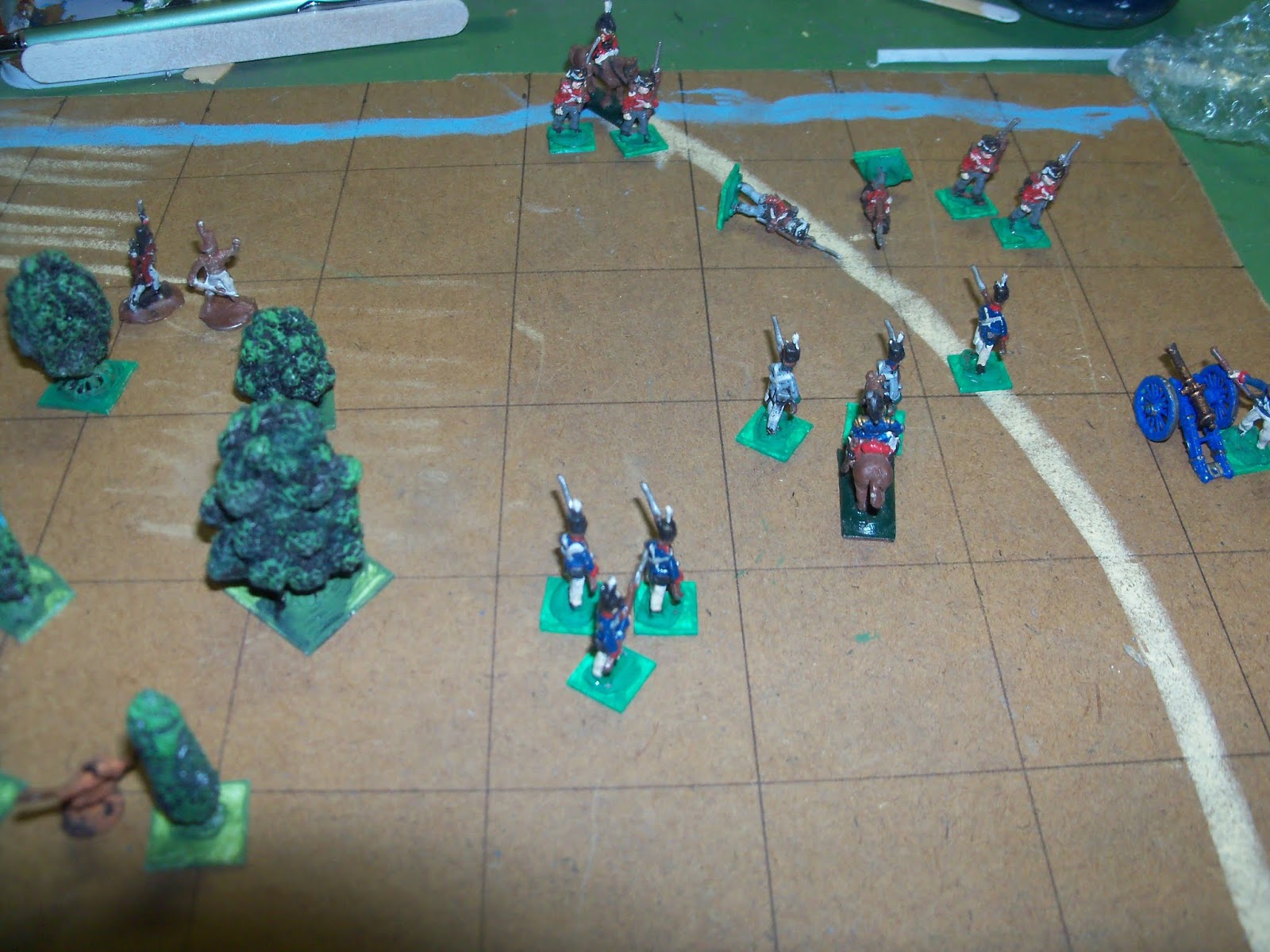 |
| The American Indians drive back the Canadian militia. One British unit is destroyed. At this point the British general falls back across the river to the defenses his army had built before the battle. The Americans return to their camp to celebrate a battle won, won on the Fourth of July! |
 |
| The four terrain cards are selected. |
 |
| The battlefield layout. After the terrain is put down, I roll for who gets which side, based on what the best use of terrain would be for the winner. The British won the roll, and chose to enter the field from the bottom of the picture. |
 |
| The board layout, with the US army on the bottom of the picture. The US army is made up of (from the left) 2 Regular infantry units, artillery, light infantry unit, 1 regular infantry, and 1 uniformed militia unit. The British at the top, are made up of (from the left) 1 militia unit, 1 regular infantry, 2 uniformed militia, artillery, and 1 regular unit. Uniformed militia are equal to Provincial infantry in C&C,T. I see them as better trained militiamen. |
 |
| After the first move. |
 |
| The American light infantry moves ahead of the army and enters the woods. The British uniformed militia also enter the woods. |
 |
| The militia in the woods get on the flank of the US light infantry and kills one; one of the regular infantry units comes under the British artillery and loses one man. |
 |
| The US light infantry drives back one militia unit. |
 |
| Closeup of the above picture. At this point I made a mistake. using C&CT unit rules, this unit should have retreated two spaces. Of course, being a game to feel out rules, it was to be expected. |
 |
| The British kill another light infantryman, and drives the artillery and one infantry unit back. |
 |
| The British lose two more uniformed militiamen from the fire of the light infantry. The British also lose two more infantrymen and a gunner. A US regular unit moves up to support the light infantry. |
 |
| The uniformed militia in the woods moves behind the light infantry. The light infantry is eliminated in the crossfire. Meanwhile the regulars come under British artillery fire and loses a man. |
 |
| On the US left, the British militia turns and runs (using the C&CT rules, militia retreats three spaces for each flag rolled.) The regulars enter the woods. |
 |
| The Americans now attack the uniform militia unit. The British general was with this unit. I rolled one flag and one crossed swords. The militia retreated off the field. I decided to roll another dice; if crossed swords came up the general was killed. I rolled crossed swords! The British militia on the American left was forced to retreat again. In most C&C games if a unit reaches it's back line and still have to retreat, they lose one man for each space it can't retreat. For me it seems the militia would just keep on retreating, so that's what they did. |
 |
| The British now concentrated their units towards the woods, and caught the infantry in the woods between three fires. |
 |
| The Americans were driven from the woods. |
 |
| The British now form a line in the woods. |
 |
| The Americans attack the woods. The uniform militia pushes their way into the British center. Meanwhile, the British militia loses two more men. |
 |
| The British catch the militia in a crossfire, and pushes them out of the woods and also off the field! The British rolled two flags; uniformed militia retreats two spaces per flag. |
 |
| One British unit moves forward, and catches one regular unit on the flank. The unit is wiped out. |
 |
| The Americans attack the woods and kill another militiaman. |
 |
| The Americans drive the militia out of the woods. |
 |
| The British counterattack and kills two infantrymen. |
 |
| At this point the British holds the woods. The next initiative goes to the British. The Americans break off their attack and retreats. |
 |
| This game was played in the bedroom near the window for natural light. If I continue with this project, I am going to try to narrow down the number of units. On my chart now there are 7 different units. I am thinking of consolidating Light Infantry(and Indians) and rifles; and uniformed militia and militia. If light infantry or militia is chosen, perhaps dice rolls would decide what kind of units they are. I am looking to make a smaller chart. My current chart has 10 different unit combinations. These combinations were just thrown together with little thought of balance. I also ran into the problem that I didn't have figures for some of the chosen units. I ended up using some of my 1st generation AWI Minifigs. Once again, if this project goes on I will need to paint up more units. |
